No Signal, No Problem: The Quiet Rebels Who Still Navigate by Feel
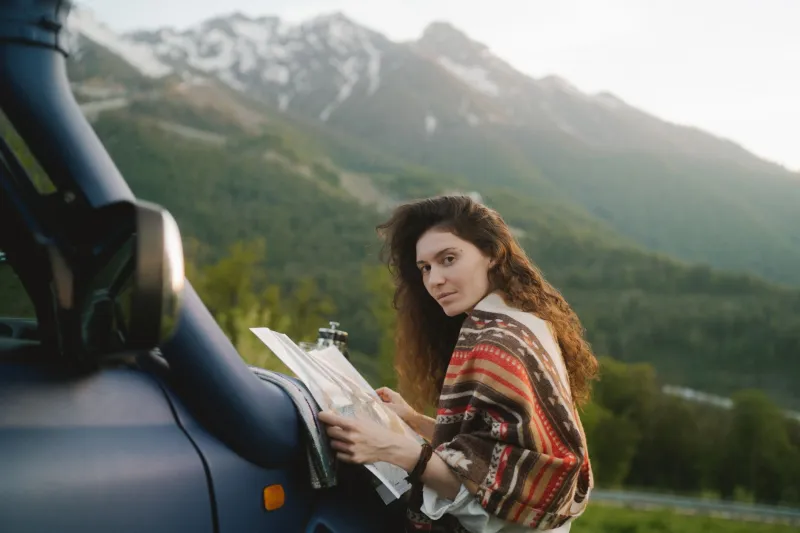
Somewhere on a two-lane highway in rural Montana, a woman named Carrie is unfolding a Rand McNally road atlas across her steering wheel at a gas station. She's not lost, exactly. She just doesn't know where she's going yet, and she's fine with that. Her phone has GPS. She's choosing not to use it.
This is not a story about technophobes. Carrie works in UX design. She knows what these apps can do. That's sort of the point.
The Brain You're Not Using
Here's something neuroscience has been quietly insisting on for a while now: wayfinding is cognitive work, and it's the kind your brain actually likes doing. The hippocampus — that seahorse-shaped structure responsible for memory and spatial navigation — lights up differently when you're actively orienting yourself in space versus when you're just following a glowing arrow on a screen.
A widely cited 2020 study out of University College London found that navigating with GPS essentially flatlines the hippocampal activity that would otherwise spike during self-directed navigation. You arrive at your destination, but your brain didn't really come with you. It was just along for the ride.
London taxi drivers — famously required to memorize thousands of routes through the city before earning their license — show measurably enlarged hippocampal regions compared to the general population. That's not a quirk. That's evidence that the brain physically reshapes itself around the skill of knowing where you are.
When we outsource that skill entirely, we don't just get lazy about directions. We may be trading away something more fundamental: a felt sense of place, of movement through space, of existing somewhere specific on the surface of the earth.
The Friction Is the Feature
Talk to anyone who still folds paper maps — and yes, they exist, and yes, they fold them badly, just like everyone always has — and a theme emerges pretty quickly. It's not that they hate technology. It's that they've noticed what frictionless navigation costs them.
"When I use GPS, I arrive places and I don't know how I got there," says Marcus, a road tripper from Austin who documents his trips on a personal blog that maybe 200 people read. "Like, I have no mental model of the drive. It's just... gone. But if I'm working off a map and making judgment calls, I remember the whole thing. The weird overpass. The town with the good diner. The spot where I guessed wrong and had to backtrack."
That backtrack matters. Getting slightly lost — not dangerously lost, but usefully lost — forces a kind of presence that optimized travel actively discourages. You have to look around. You have to read the landscape. You have to think.
Urban explorers have known this for decades. The practice of dérive — drifting through a city without a fixed destination, letting the environment pull you — was formalized by the Situationists back in the 1950s, but it describes something people had always done instinctively before apps made wandering feel like a failure state. Plenty of people in cities like New York, Chicago, and Portland still do it. They'll pick a direction and walk until something interesting stops them. No pins. No routes. No estimated arrival time.
What a Map Actually Is
There's something philosophically interesting about a paper map that gets lost in the GPS conversation. A map is not a live feed. It's a model — someone's interpretation of a landscape, drawn at a particular moment in time, with particular choices about what to include and what to leave out. Using one requires you to reconcile the model with reality. That reconciliation is an active, interpretive act.
GPS, at its best, collapses that gap entirely. The map is reality, updated in real time, perfectly calibrated to your position. There's no interpretation required. Which means there's no engagement required either. You become a passenger in your own trip.
Paper map people tend to be weirdly good at cardinal directions. They think in terms of north and south rather than left and right. They build what researchers call a "cognitive map" — an internal representation of space that persists after the trip ends. Ask them about a drive they took five years ago and they can sketch the rough geography. Ask someone who GPSed the same route and they'll probably remember the podcast they were listening to.
Choosing Hard on Purpose
What makes this community interesting — and why it fits into a broader cultural moment — is that they're not doing this out of ignorance. They're doing it as a deliberate practice, the same way some people handwrite notes in an age of keyboards, or develop film in an age of digital cameras, or cook from scratch when DoorDash exists.
The common thread isn't nostalgia. It's intentionality. A recognition that efficiency isn't always the metric that matters. That some friction isn't a bug to be engineered out — it's the actual experience.
There's a version of this that's purely recreational. The road tripper who wants the full sensory experience of a drive, not just the destination. The hiker who thinks a trail map and a compass are part of the adventure. The city wanderer who believes you can't really know a neighborhood until you've gotten turned around in it at least once.
But there's also a version that's more quietly political. Every time you open Google Maps, you're feeding data back into a system that uses it to optimize traffic flows, serve location-based ads, and build an increasingly detailed model of your movements. Opting out — even occasionally, even imperfectly — is a small act of spatial sovereignty.
You Don't Have to Go Full Atlas
Nobody's saying throw your phone in a river. The point isn't purity. It's more like: maybe try driving somewhere unfamiliar without checking the route first. See what happens. Get a little lost. Look for landmarks instead of turn-by-turn instructions. Notice what your brain does when it has to actually work.
Carrie, back at that Montana gas station, eventually figures out which road she wants. She refolds the map — imperfectly, like everyone does — and gets back on the highway. She doesn't know exactly how long it'll take to get where she's going. She has a rough sense of the direction and a willingness to course-correct.
She says it's the best way she's found to actually be somewhere, instead of just passing through it.
That distinction — between being somewhere and passing through it — might be the whole argument, right there.