Seven Digits You Used to Own: What Happened When We Handed Our Memory to a Machine
Ask someone for their own cell phone number right now. Go ahead. Most people get about four digits in before they start guessing. They'll squint, tilt their head, maybe even pull out their phone to check — the phone that is their number — because they genuinely don't know.
This isn't a moral failing. It's a design outcome. But it's a strange one, and once you notice it, you can't really stop thinking about what it means.
The Rolodex in Your Head
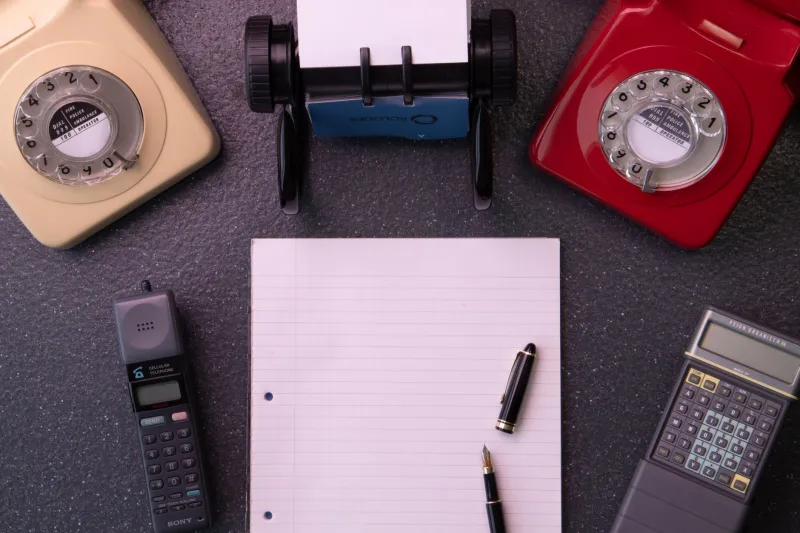
Before smartphones, before even cell phones, most Americans carried somewhere between ten and thirty phone numbers in active memory. Mom. Your best friend. The pizza place on the corner. Your own number, obviously, because you had to give it to people. Memorizing a phone number wasn't a skill — it was just what you did when someone mattered to you.
There was even a physical ritual to it. You'd write the number down, repeat it a few times, maybe dial it wrong once or twice, and eventually it would just stick. Cognitive psychologists call this kind of memory consolidation "rehearsal encoding" — the brain filing something away through repeated use. Phone numbers were perfect candidates for it: short, structured, just long enough to require actual effort.
That effort, it turns out, meant something.
"There's a reason we associate certain numbers with emotional weight," says Dr. Maria Feld, a cognitive neuroscientist who studies memory outsourcing at a research university in Chicago. "When you memorize someone's number, you're not just storing data. You're making a small, repeated commitment to that person every time you rehearse it. The memory becomes entangled with the relationship."
She pauses. "When you don't have to do that anymore, the entanglement doesn't really happen the same way."
The Contacts List as a Trust Transfer
Here's the quiet trade that happened around 2005 to 2010, somewhere in the gap between flip phones and the first iPhones: we stopped knowing people's numbers and started trusting a piece of software to know them for us.
On the surface, totally reasonable. More efficient. Fewer wrong dials. But what actually shifted wasn't just convenience — it was the locus of trust. You used to trust yourself to hold that connection. Now you trust the device. And the device, notably, doesn't care about your relationship with your college roommate.
Kate Brennan, 38, lives in Portland and works in UX design. She's one of a small but apparently growing number of people who still deliberately memorize phone numbers. She currently has eleven committed to memory, including her parents, her two closest friends, her therapist, and her landlord.
"I started doing it after my phone got stolen at a concert," she says. "I was standing on the street, totally stranded, and I realized I couldn't reach a single person in my life. Not one. I didn't know anyone's number. I didn't even know my own sister's number."
She borrowed a stranger's phone and stood there, useless. "It felt like a breakup. Like I'd been in all these relationships and suddenly I found out they weren't real — they were just stored in a thing I didn't have anymore."
She's been memorizing intentionally ever since. "It's not even that hard," she says. "It just takes about a week of actually trying."
What the Science Says About Cognitive Offloading
Researchers have a name for what we've done with our contacts lists, our GPS apps, our calendar reminders: cognitive offloading. The idea is that humans have always used external tools to extend mental capacity — writing things down, tying strings around fingers, building libraries. Outsourcing memory isn't new.
But the scale and intimacy of what we're offloading now is new, and some researchers think it's changing the architecture of how we relate to information — and to each other.
A well-cited 2011 study out of Columbia University found that when people expect to have access to information later (say, stored on a computer), they're less likely to actually remember the information itself — but more likely to remember where to find it. The brain, essentially, stops bothering to encode the content and just encodes the retrieval path instead.
Applied to phone numbers: you don't know your best friend's number. You know that it's in your phone under "Jamie." You've outsourced the knowing to the device and kept only the pointer.
"The concerning part isn't that we offload," Dr. Feld says. "It's that we've offloaded things that used to carry relational meaning. There's a difference between outsourcing where you parked your car and outsourcing the phone number of the person you'd call in an emergency."
The Emergency Test
There's an informal thought experiment that's been circulating in certain corners of the internet for a few years now, usually framed as a preparedness question: if your phone died right now, who could you actually reach?
For most people, the answer is one or two people, if that. Maybe a parent, if you grew up calling them on a landline. Maybe a childhood friend whose number hasn't changed since the flip phone era.
Marcus Webb, 44, a high school history teacher in Atlanta, thinks about this a lot. He still knows his mother's landline number — the one she's had since 1987 — and his wife's cell. That's it.
"I know my students' parents have numbers in their phones for me," he says, "but if something happened and they needed to reach me and their phone was dead? Gone. That connection is gone. And that feels like it should bother more people than it does."
He's not wrong. The emergency scenario reveals something that normal day-to-day life keeps hidden: our social networks are increasingly mediated by a single point of failure. The phone. The app. The cloud backup that may or may not have synced.
Knowing Someone vs. Having Their Contact
There's a distinction worth sitting with here. In 2025, you can "have" someone — follow them, save their contact, be connected on four platforms — without knowing a single thing about them that isn't stored in a database somewhere. The relationship exists in the infrastructure, not in you.
That might be fine for acquaintances. But somewhere along the line, we applied the same logic to the people who matter most, and we barely noticed.
Kate Brennan puts it simply: "Memorizing someone's number is a way of saying they live in me, not just in my phone. There's a difference. I want there to be a difference."
She's onto something. Not because the number itself is sacred, but because the act of memorizing it — the small, repeated effort of choosing to hold someone in your actual mind — is a form of intimacy that convenience quietly made optional.
We opted out. Most of us didn't even realize we were being asked.
So What Do You Do With This?
This isn't a call to delete your contacts app or start carrying an address book (though, honestly, some people are doing that and seem pretty okay). It's more of an invitation to notice the trade.
Every time we hand something to a machine, we get something back — speed, efficiency, reduced friction. But we also give something up. With phone numbers, we gave up a small but real form of relational memory. The question isn't whether the trade was worth it. The question is whether we knew we were making it.
Pick one number. Someone who matters. Learn it this week.
See if it feels different to know them that way.