I Tried to Live Like It Was 2003 for a Month. Here's What Actually Happened.
I Tried to Live Like It Was 2003 for a Month. Here's What Actually Happened.
The rules were simple, which is how I knew I was underestimating them.
For thirty days: no smartphone navigation, cash only, printed photos instead of camera rolls, phone calls over texts where possible, and no social media of any kind. I'd use a physical planner. I'd get a paper map of my city. I'd look things up at home, on a laptop, like some kind of Victorian scholar with a Wi-Fi connection. The goal wasn't to go full Walden — I wasn't moving into the woods — but to deliberately step back from the frictionless digital infrastructure I'd been floating on for the better part of a decade.
I lasted about forty minutes before the first failure.
Day One: The Map Situation
I live in Chicago. Chicago has a grid system that is, in theory, extremely logical. I grew up here. I should be fine.
I was not fine.
The problem wasn't the grid. The problem was that I've been outsourcing my spatial memory to Google Maps for so long that I genuinely couldn't remember which direction was north without pulling out my phone. I stood on a corner in Wicker Park for four minutes — I counted — physically rotating a paper map until I felt confident enough to walk two blocks.
 Photo: Google Maps, via androidayuda.com
 Photo: Wicker Park, via wallpapers.com
A teenager watched me do this. She did not look impressed.
This is not a small thing. Navigation is one of those skills that feels automatic until you realize the automation isn't in your brain — it's in your pocket. Without it, I was slower, more anxious, and weirdly more present. I noticed things I'd walked past a hundred times. I also missed a meeting by twelve minutes because I took the wrong bus.
The Cash Economy Is a Parallel Universe
Week one also introduced me to the cash problem. I'd forgotten how much of American daily commerce is now quietly hostile to paper money. Not illegal, not rude — just inconvenient in ways that feel designed to nudge you back toward your card.
Several food trucks in my neighborhood were card-only. One coffee shop had a sign that said "we prefer contactless" in the exact tone of voice someone uses when they technically can't say no but really want to. An ATM charged me $3.50 in fees, which felt like a tax on my principles.
What I did notice was that I spent less. Not because I'm more virtuous when using cash — it's that physically handing over a twenty makes the transaction feel more real than tapping a phone. Behavioral economists have been saying this for years. Turns out they're right, and it's slightly annoying to discover this about yourself in your thirties.
Calling People on the Phone Is Now a Social Event
I don't have a landline, so I bent the rules slightly: I'd call instead of text, but on my regular phone. What I didn't anticipate was how deeply weird this would feel to everyone in my life.
My friend Marcus, when I called him to make plans instead of texting, answered with genuine concern in his voice. "Is everything okay?" he asked. I explained the experiment. There was a pause. "So you're just... calling people now?"
Yes. Yes I am.
What followed was a twenty-minute conversation that would have been a three-message text exchange. We talked about stuff that doesn't fit in a text — his job, my sleep schedule, a movie neither of us could remember the name of. It was, genuinely, nice. It was also something I had to schedule, because calling someone without warning in 2024 is apparently the equivalent of showing up at their house unannounced.
The phone call is not dead. It has just become a special occasion.
The Printed Photos Thing Was the Strangest Part
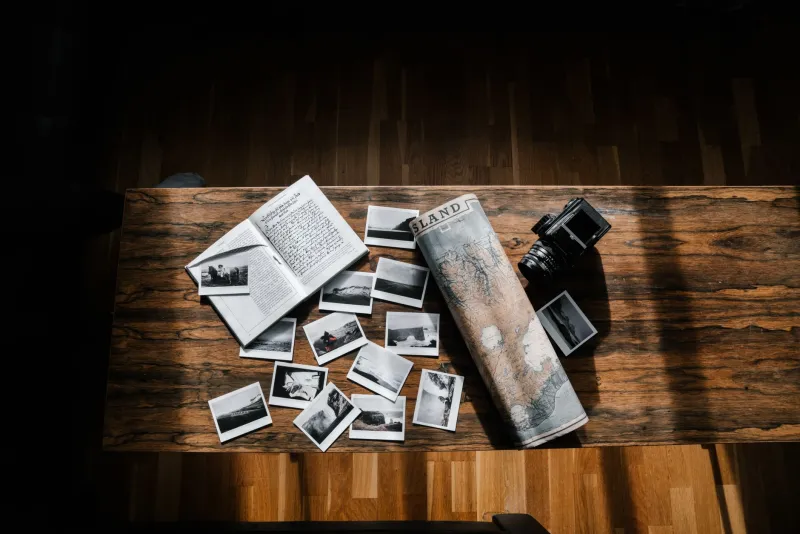
I ordered physical prints through a mail service at the start of the month — about forty photos from the past year — and put them in a small album. The experience of looking at them was completely different from scrolling a camera roll. Slower. More selective. You notice things in a print that you swipe past on a screen.
I also showed them to my mom, who was visiting in week two. She held each one. She commented on each one. We sat there for forty minutes going through forty photos, which is approximately forty times longer than I've ever spent on someone's Instagram.
I'm not drawing a sweeping conclusion from this. But it was different. Noticeably different in a way I don't fully have the language for yet.
What I Actually Learned (Which Is Less Cinematic Than You'd Hope)
Here's what I won't do: wrap this up with a clean lesson about presence and intentionality and how I'm a changed person. That would be dishonest.
The honest version is this: I failed the rules constantly. I used my phone's GPS twice in genuine emergencies. I checked Twitter once during week three because there was a news event and I couldn't stand not knowing. I used a QR code menu at a restaurant because the paper version was sticky and I have limits.
What the experiment actually showed me wasn't that I should live like it's 2003. It showed me how thoroughly digital systems have embedded themselves into the basic infrastructure of American daily life — not as luxury features, but as load-bearing walls. Removing them doesn't return you to some simpler version of yourself. It mostly just reveals how much invisible scaffolding you've been standing on.
That's worth knowing. Not because the scaffolding is bad, but because you should probably understand what's holding you up.
The map thing, though. I'm keeping the map thing. Turns out knowing which direction you're facing without asking your phone is a genuinely useful skill, and also mildly satisfying in a way that's hard to explain to people who haven't experienced it.
Everything else? I'm back online. Obviously.