Stuck at 16: The Songs You Couldn't Skip Are Still Making Decisions for You
Stuck at 16: The Songs You Couldn't Skip Are Still Making Decisions for You
Somewhere between your first heartbreak and your last summer without real responsibility, a playlist got written into you. Not metaphorically. Literally encoded — grooved into the architecture of a brain that was, at that exact moment, undergoing one of the most volatile rewiring projects of your entire life. You didn't choose it consciously. You just kept hitting repeat.
And here's the part nobody talks about at your high school reunion: that playlist never stopped playing.
The Neuroscience Nobody Warned You About
Researchers have a term for this: the "reminiscence bump." It's the well-documented phenomenon where adults consistently recall memories from ages 10 to 25 more vividly than memories from any other period of life. Psychologists have studied it for decades, but the music angle is particularly sharp.
During adolescence, your brain is flooded with dopamine at levels you'll basically never experience again at the same intensity. Simultaneously, you're encountering everything — music included — for the first time, without the protective layer of context and comparison that adult experience builds up. A song that hits you at 16 doesn't just hit you. It fuses with whatever you were feeling in that moment: the specific ache of a crush who didn't know your name, the specific freedom of a late Friday night with nowhere you had to be.
Daniel Levitin, a neuroscientist and musician who wrote This Is Your Brain on Music, has argued that musical preferences are essentially locked in during this window. The emotional memory systems and the auditory cortex are in rare alignment during adolescence, creating what amounts to a permanent index. Every song that lands during that window gets filed under "this is what things feel like when they matter."
The unsettling part: your adult brain keeps consulting that index without asking your permission.
It's Not Nostalgia. It's Infrastructure.
Here's where it stops being a warm fuzzy story about mixtapes and becomes something more like a software audit.
Nostalgia is passive. You hear "Mr. Brightside" at a bar and you smile because you remember being 17. That's fine. That's human. But what researchers are increasingly pointing out is that the influence runs deeper than fond recollection. The music you imprinted on during adolescence doesn't just make you feel something when you hear it — it becomes a template for what feeling something is supposed to feel like.
Think about the music you reach for when you're genuinely sad. Not performatively sad, not "I need a cry" sad — actually gutted. Chances are, it's something from that era. Not because those songs are objectively the saddest, but because your brain learned what emotional processing sounds like during that window, and it keeps returning to the source code.
Same goes for joy, for anger, for the specific restless energy of wanting something you can't name. The emotional grammar you use as an adult was largely written between seventh and twelfth grade, and music was one of the primary languages.
The Cultural Fingerprint Problem
This gets even more interesting when you zoom out and look at it generationally.
Millennials who came of age during the mid-to-late '90s carry Nirvana and TLC and Lauryn Hill as emotional infrastructure. Gen X has The Cure and Public Enemy and Fleetwood Mac. Older Gen Z has Lorde, Kendrick, and the chaotic emotional whiplash of SoundCloud rap. Each generation doesn't just remember its music — it thinks through its music. It processes grief through the chord progressions it learned were appropriate for grief. It understands romantic longing through the melodic shapes it absorbed before it had the language to name what longing even was.
This is part of why music is such a reliable culture war flashpoint. When someone dismisses the music that defined your adolescence, they're not just criticizing your taste. They're critiquing the operating system you built your emotional life on. Of course it feels personal. It basically is.
Your Relationships Might Have a Tracklist
Here's the part that might make you want to close this tab and think about something else for a while.
Psychologists studying attachment and emotional regulation have noted that the emotional patterns we develop during adolescence — including those reinforced by the music we consumed obsessively — tend to show up in our adult relationships. The kinds of love stories your teenage anthems told you were worth wanting, the emotional dynamics those songs normalized, the pain they taught you to romanticize: all of it gets baked in.
If you spent your formative years marinating in music that glorified emotional unavailability as depth, or chaos as passion, or self-destruction as authenticity — and a lot of popular music across every decade has done exactly that — you may have absorbed those as features rather than bugs. Not because you're naive, but because the imprinting happened before your critical faculties were fully online.
This isn't about blaming Morrissey for your attachment issues. It's about recognizing that the stories music told you, at the exact moment you were figuring out who you were, had real downstream consequences.
The Audit Nobody Assigns
There's no clean resolution here, which is kind of the point.
You can't uninstall the playlist. You can't go back and curate a more emotionally healthy teenage music diet. What you can do is start noticing the moments when that old software is running — when you reach for a specific song in a specific emotional state and recognize that you've been running that same loop for fifteen years. When a certain chord progression makes you feel seventeen again in a way that's less charming and more revealing.
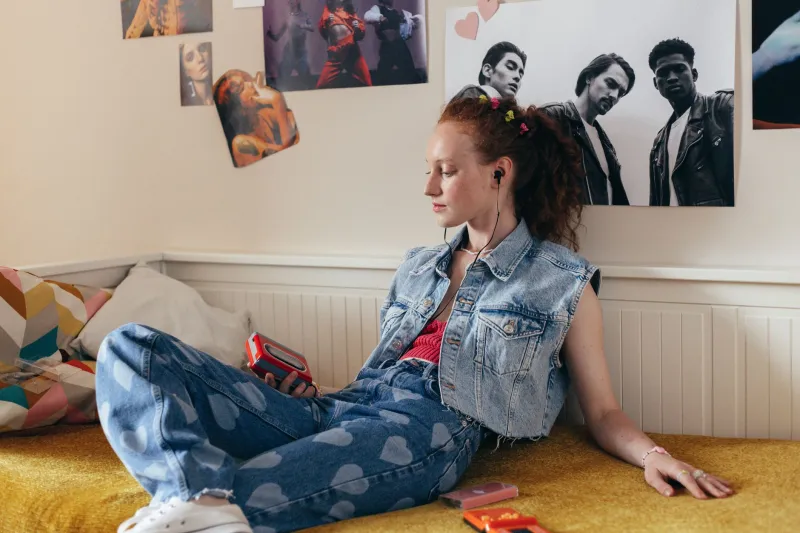
There's actually something kind of remarkable about it, once you stop feeling weird about it. You are, in some measurable neurological sense, still the person who sat in their bedroom and played that album until they knew every breath and pause. That person isn't gone. They're just running quietly in the background, occasionally hijacking the controls.
The question worth sitting with isn't "how do I get over my teenage music taste." It's more like: what did those songs teach me to feel, and is that still what I want to be feeling?
Because the playlist built you. But you're the one deciding whether to keep the same settings.