The Password on a Post-It Note: When Sharing Wi-Fi Was How You Met Your Neighbors
Somewhere between the late 2000s and the early part of this decade, a small, strange social ritual died without a funeral. It didn't make headlines. Nobody wrote a think piece in time to save it. It just stopped happening, quietly, the way most things we didn't know we needed tend to disappear.
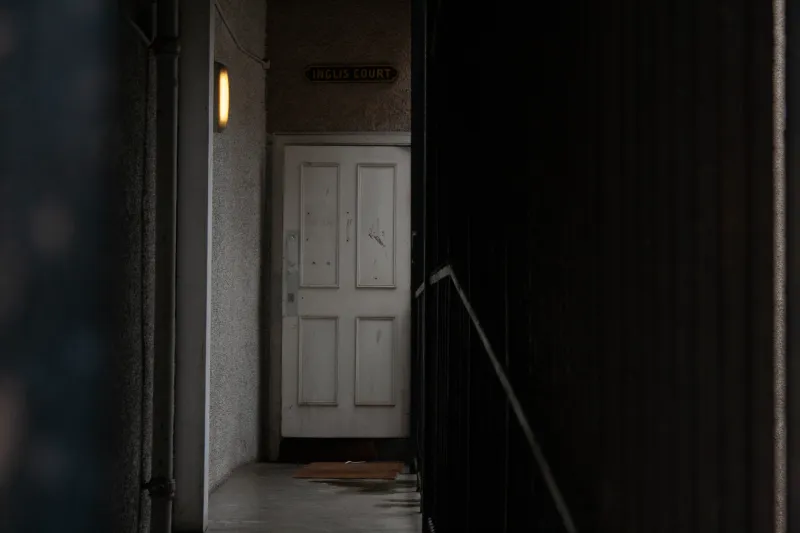
The ritual was this: you moved somewhere new, you didn't have internet yet, and you knocked on a door.
The Knock That Started Everything
Ask anyone who lived in an apartment building around 2009 and they'll probably have a version of this story. You'd just moved in. The router was still in a box somewhere, or the install window was three weeks out, or you were a broke college sophomore who simply couldn't justify another bill. So you did the thing. You walked down the hall. You knocked.
What happened next was almost never just a password exchange. It was a conversation. Sometimes a short one — a scribbled note, a quick handshake, back inside in under two minutes. But sometimes it turned into a beer on the porch, a standing invitation, a person you'd actually wave to in the parking lot instead of studying your phone to avoid eye contact. The Wi-Fi was the pretext. The connection was the point.
College dorms ran on this economy for years. Cul-de-sacs had their own informal sharing networks. Apartment floors developed a kind of loose digital commons where three or four units split a Comcast bill and everyone had the same SSID burned into their memory. LinksysNorthApt4B. DontHackMeBro. PrettyFlyForAWifi. These were the passwords people actually used, and they traveled by word of mouth.
Infrastructure as Introduction
There's a concept in urban design called a "third place" — somewhere that's not home and not work, where community forms organically. A coffee shop. A front stoop. A corner store. Wi-Fi sharing, at its peak, was something like a digital third place with an analog entry point. The network itself was invisible, but getting access required a physical, human interaction. That friction was the feature.
What made it work was precisely what made it inconvenient. You couldn't just tap a screen. You had to show up. And showing up — even for something as mundane as internet access — created the conditions for something harder to manufacture: familiarity.
Researchers who study social isolation will tell you that repeated, low-stakes interactions between neighbors are the foundation of community trust. Not big moments. Not block parties or emergency situations. Just: hey, I've seen your face before and I know your name. Borrowing a Wi-Fi password was, absurdly, one of the last reliable generators of exactly that kind of interaction for a generation of Americans who'd otherwise outsourced most of their social infrastructure to apps.
What Killed the Knock
The culprit isn't dramatic. It's just the natural evolution of the market.
Personal hotspots became standard on smartphones around 2010 and 2011. Data plans got bigger. Home internet became easier to set up, faster to install, cheaper to maintain on your own. The friction disappeared — and with it, the reason to knock.
By the mid-2010s, the idea of sharing a neighbor's Wi-Fi had quietly shifted from a normal, neighborly thing to something that felt vaguely transgressive. Whose network is that? Should I be on it? The social permission had evaporated. The infrastructure that once required community to function had been individually optimized, and the side effect — the conversation, the introduction, the name you'd remember — had been optimized away right along with it.
Nobody decided this was the trade-off they wanted. It just happened, the way so many small losses happen: incrementally, invisibly, until one day you realize you've lived in your building for two years and you'd struggle to pick your next-door neighbor out of a lineup.
The Irony That Still Stings
Here's the part that's hard to shake: the technology that made us more connected — more bandwidth, more devices, more reliable access — did it by making us less dependent on each other. And dependence, it turns out, is not always a bad thing. Managed dependence is what a neighborhood is. It's what a community is. The mild inconvenience of needing something from someone nearby is one of the oldest reasons humans have ever introduced themselves.
We engineered that inconvenience out of the equation and called it progress. And in a lot of ways, it was. But we didn't account for what we were giving up in the margin.
There are still places where the old ritual survives. Small apartment buildings with landlords who put the Wi-Fi password on a laminated card in the hallway. Vacation rental communities where a shared network is just how it works. Rural areas where one household's satellite dish becomes a neighborhood resource by necessity. In these places, people still know their neighbors' names. Whether that's correlation or causation is hard to prove, but it's hard not to notice.
Maybe the Point Was Never the Internet
Look, nobody is suggesting we go back to splitting a 15 Mbps DSL connection four ways and calling it community building. The old system was slow and annoying and occasionally a nightmare when someone on the shared network decided to torrent an entire TV series at 2 a.m.
But there's something worth sitting with here. The version of connectivity we built — seamless, individual, always-available — solved every technical problem and created a social one we're still trying to name. We live in the most networked moment in human history and consistently report feeling more isolated than the generations that came before us.
Maybe some of that is the post-it note's fault. Or rather, the absence of it.
The password on the post-it note wasn't just a password. It was an invitation. It said: I trust you enough to let you into something of mine. That's a small thing. But small things, repeated across a hallway or a cul-de-sac or a dorm floor, are how people become neighbors instead of strangers who happen to share a zip code.
We got faster internet. We lost the knock. Most days, the trade feels fine. Some days, it doesn't.