Held in Your Hands: The Die-Hards Who Still Show Up for Release Day
It's a Tuesday morning in mid-October and Marcus Webb is already in his car. It's 9:47 a.m. He has a coffee in the cupholder and a short list on his phone — not a playlist, an actual list, written in the Notes app like a grocery run. Two LPs. One CD, because the CD has a bonus track the vinyl doesn't. He's been doing this, more or less, since he was seventeen years old in suburban Columbus. He's thirty-four now.
"I know how it looks," he says, laughing a little. "My coworkers think I'm insane. They're like, 'you know you could just... listen to it right now.' And yeah. I know. That's not the point."
The point, for Marcus and a quietly passionate community of physical media devotees scattered across the country, is something harder to explain to a streaming-native world. It's about the weight of the thing. The smell of the sleeve. The way liner notes force you to sit still for a minute and actually read something. It's about committing to an album the way you used to commit to anything — fully, physically, with money you actually spent.
Release Day Used to Mean Something Different
For most of recorded music history, release day was an event by default. If you wanted to hear the new Springsteen record, you went and got it. There was no other option. The anticipation built for weeks through magazine coverage and radio snippets, and then — finally — there it was, shrink-wrapped and waiting on a shelf.
Streaming didn't just change where the music lives. It changed the texture of the experience entirely. A new album now arrives the way a notification arrives: silently, instantly, sandwiched between everything else. You might hear about it from an algorithm before you hear about it from a friend. It autoplays. It disappears into a queue. And because nothing is truly owned — because your library is technically a rental contingent on licensing agreements that can evaporate overnight — nothing quite lands the same way.
That impermanence is, for a lot of collectors, the crux of it.
"I've had songs just vanish," says Priya Nair, who works at a mid-sized independent record shop in Portland and collects everything from jazz reissues to hyperpop on 7-inch singles. "Like, I had a playlist I'd built over two years and three tracks just disappeared because some label deal fell through. You can't do that with a record. It's yours. No one can take it."
The Object as Argument
There's a philosophical case buried inside every shrink-wrapped LP, and the people who still buy them tend to feel it even if they don't always articulate it out loud. Owning a physical album is a small act of insistence — a refusal to let music become purely ambient, purely functional, purely background.
Artists who still invest in physical packaging notice this too. Jonah Ferris, who releases music under a project name he'd prefer not to have publicized ("I'll get weird DMs"), spent nearly three months designing the insert booklet for his last record. Hand-lettered lyrics. Film photographs. A folded map of the neighborhood where the album was recorded. He pressed five hundred copies. He sold four hundred and eighty-six of them directly through his website.
"Nobody asked for any of that," he admits. "But the people who got it — I still hear from them. They'll send me a picture of it on their shelf. That doesn't happen with a Spotify stream. You don't display a stream."
That display instinct is real and worth taking seriously. A record collection is a form of autobiography. It communicates something about who you are and what you've cared about, in a way that a private Spotify library — invisible, unshared, endlessly mutable — simply cannot.
The Store as Community
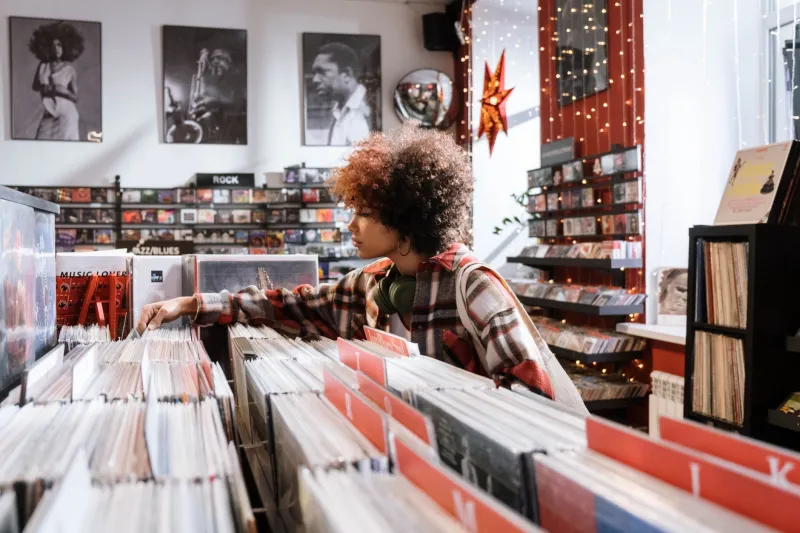
Record Store Day, the annual April event that's become something of a secular holiday for the vinyl faithful, draws lines around the block at independent shops from Asheville to Albuquerque. But the collectors who really live this aren't just showing up once a year for limited pressings. They're regulars. They have relationships with the people behind the counter. They get texts when something comes in.
"My regulars, they're not shopping," says Delilah Okonkwo, who manages a small shop in Chicago's Logan Square neighborhood. "They're checking in. It's social. They want to know what I think, what's been selling, what some nineteen-year-old bought last week that surprised me. The record is almost secondary sometimes."
This is something streaming platforms have never successfully replicated — the serendipity of a physical space curated by a human being with opinions. An algorithm can surface music you might like. It cannot argue with you about it.
Nostalgia or Resistance — Why Not Both?
The easy read on all of this is nostalgia. A bunch of people who grew up before Spotify, clinging to a format because it feels like home. And sure, there's some of that. Marcus will be the first to admit that part of why release day matters to him is that it mattered to him when he was seventeen, and that continuity feels valuable.
But the younger collectors — and there are more of them than you'd expect, kids in their early twenties who grew up fully digital and chose vinyl anyway — don't have that nostalgia to fall back on. For them, it's something else. It's resistance, maybe. Or just a preference for depth over convenience.
"Convenience is fine," says Priya. "Convenience is great, actually. But convenience doesn't make you feel anything. And I got into music because it made me feel things."
There's something in that worth sitting with. The formats that survive aren't always the ones that win on efficiency. Sometimes the ones that survive are the ones that refuse to let you be passive — the ones that ask something of you in return.
A record asks you to get up and flip it. It asks you to read the credits. It asks you to care enough to go get it in the first place.
Marcus pulls into the parking lot of the record shop at 10:03 a.m. The store opens at ten. There are two other people already waiting by the door.
He recognizes one of them. They nod at each other the way regulars do — not quite friends, not strangers either. Just two people who showed up.