Making Things for Nobody: The Quiet Revolution of Creators Who Refuse to Feed the Machine
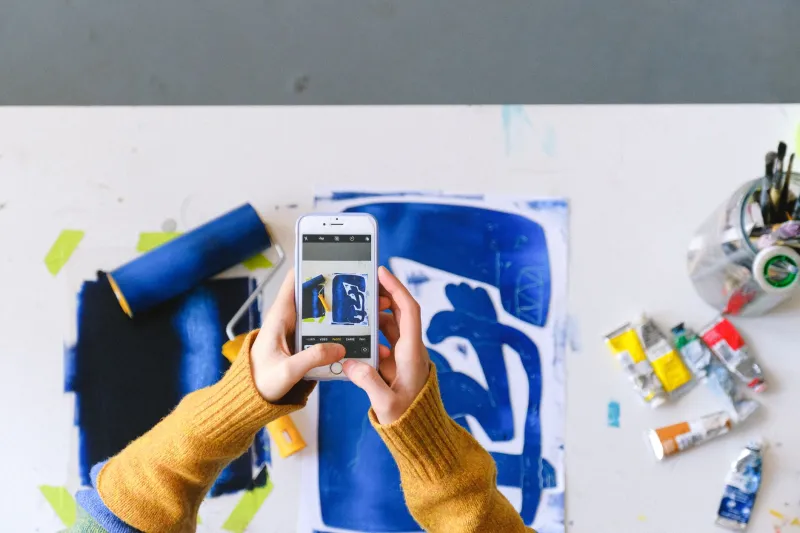
There's a painter in Portland who doesn't have an Instagram. She has a website — the kind built on a free host with a slightly ugly font and no call-to-action button anywhere on it. She updates it when she finishes something. She doesn't post on a schedule. She doesn't use keywords. If you find her, it's because someone sent you a link in a text message, probably with a "you just have to look at this" attached.
She's not an anomaly anymore.
Across the US, a loose and largely unorganized movement is taking shape among creators who are, deliberately and sometimes defiantly, building work that has no interest in being discovered by an algorithm. No trending hooks. No SEO strategy. No engagement bait. Just the thing itself, existing on its own terms.
It sounds almost quaint. It might actually be the most interesting thing happening in creative culture right now.
What Gets Lost When Every Decision Becomes a Performance
Here's the thing about optimizing for an algorithm: it works. Posts that follow the pattern get seen. Content that hits the right emotional register at the right length gets pushed. The feedback loop is real and it's fast, and for creators trying to build an audience, ignoring it feels like showing up to a gunfight with a sketchbook.
But there's a cost that doesn't show up in the analytics dashboard.
When every creative decision gets filtered through the question of will this perform, something fundamental shifts in the work itself. Writers start front-loading their strongest observations because readers bounce in the first three seconds. Musicians sequence albums for streaming rather than for the arc of a listen. Visual artists start gravitating toward palettes and compositions that photograph well on a phone screen — not because those are bad choices, but because they're strategic ones.
The work starts to answer a question it was never originally asked.
A novelist based in Chicago who writes serialized fiction and distributes it exclusively through a paid newsletter — no social media, no Substack recommendations, just a link on a few message boards — described it this way: "I started noticing that I was writing toward the reaction instead of toward the truth. And those are not the same destination."
He now has a few hundred readers. He's written the best work of his life, by his own account. He's completely fine with both of those things being true simultaneously.
The Communities Forming in the Gaps
What's interesting is that this isn't just a solo act. Pockets of community are forming around algorithm-resistant work, and they have a texture that feels genuinely different from platform-native fanbases.
There are zine fairs in Brooklyn and Austin where the explicit ethic is no QR codes, no handles, no links. You either buy the thing or you don't. There are Discord servers — small ones, the kind with 200 members who all actually talk to each other — built around sharing music that nobody's trying to promote. There are email chains, actual email chains, passing around short fiction and essays with no comment sections attached.
The communities tend to be smaller. They also tend to be stickier. When someone finds the Portland painter through a text message, they usually stay found.
This isn't nostalgia for some pre-internet golden age, exactly. Most of these creators aren't anti-technology. They use it constantly. They're just making a specific, considered choice about which parts of the technology stack they're willing to let shape what they make. That's a different posture than rejection. It's more like negotiation.
The Radical Act of Making Something Nobody Asked For
There's a useful frame here from the world of music. When bands in the early 2000s started self-releasing records on CD-Rs and selling them out of milk crates at basement shows, the mainstream music industry mostly ignored them. The point wasn't to be ignored — the point was that the music was being made anyway, for the people in the room, and if the industry didn't have a category for it, that was the industry's problem.
Something similar is happening now, just distributed differently. A musician in Atlanta is releasing albums with no streaming presence — physical only, sold through her own site, no Spotify, no Apple Music. She's not making a political statement, she says. She just found that the moment she put something on a platform, she started making decisions based on what the platform rewarded, and those decisions didn't feel like hers anymore.
That's the thread running through almost every creator working in this mode: the desire to keep the decision-making internal. To ask is this true before asking will this land.
Which, when you think about it, is just the oldest definition of artistic integrity dressed up in the language of 2024.
What Gets Found When You Stop Optimizing
Here's what the creators in this space consistently report finding on the other side of the choice: weirdness. Specificity. Stuff they didn't know they were interested in until they stopped steering toward what they knew would work.
The novelist in Chicago started writing a chapter from the perspective of a building. Not a character in a building — the building itself. He would never have done that if he'd been thinking about retention rates.
A visual artist in Los Angeles, who used to run a design account with 40,000 followers and now posts her personal work to a Tumblr she doesn't publicize, started making pieces that take three months to finish. "Nobody waits three months for content," she said. "But they're the best things I've made. They're so slow. I love them."
Slow. That word comes up a lot.
There's something almost countercultural about slowness right now — not slow as a brand identity (that's been commodified too), but slow as a genuine operational choice. Making something that takes a long time because the thing requires it. Releasing it when it's done. Letting it find its people at whatever pace it finds them.
The Tension That Doesn't Resolve
None of this comes without real tradeoffs. Choosing to opt out of algorithmic distribution is, in practical terms, a choice to reach fewer people. For creators who depend financially on their work, that's not an abstract consideration — it's a rent payment.
And there's a class dimension worth naming: the ability to make work without worrying about whether it performs is a privilege not everyone has equal access to. The Portland painter has a day job. The Chicago novelist has a partner with stable income. The opt-out is easier when the stakes are lower.
So this isn't a manifesto for everyone. It's not even a manifesto. It's more of an observation that some people are finding something real on the other side of the optimization question, and the work they're making has a quality to it that's hard to name but easy to feel.
You know it when you find it. Usually because someone sent you a link in a text message.
Usually with a "you just have to look at this" attached.